1. General
The Real Time Contest (RTC) is a global amateur radio event built for exciting, live, and fully interactive competition. Everyone is welcome to join the action! To ensure real-time scoring and official results, participants must provide their log to be uploaded to the RTC server in Real Time https://hamscore.com for the entire duration of the contest.
THERE IS the ONLY ONE OFFICIAL online Scoreboard for the RTC contest. It’s published at https://hamscore.com/scoreboard/?contest_id=1
The contest will be in a mixed mode format (CW and SSB). Each station may be worked only ONCE per band on CW, and ONCE per band on SSB.
Bands: 40m, 20m, 15m, 10m.
The recommended frequencies:
CW mode:
first 50 kHz of CW band
SSB mode:
40 – 7.125 – 7.200
20 – 14.200 – 14.300
15 – 21.250 – 21.350
10 – 28.400 – 28.500
Cabrillo name: RTC
2. Contest Duration
Total duration: 4 hours
The next provisional schedule: Sunday, November 1 2026 at 16:00 UTC – 20:00 UTC *
3. Exchange
Each QSO must include the following exchange:
– QSO serial number, starting with 001
– 4-character grid locator
Signal reports (59 / 599) or any other reports should also be present but they are not be checked as a part of exchange.
Example: 599 001 FN36 or 59 001 FN36
4. Scoring
QSO Points (distance-based):
1 point — up to 1,999.99 km
2 points from 2,000.00 up to 3,999.99 km
3 points — from 4,000.00 up to 7,999.99 km
4 points — from 8,000.00 km and over **
** Distance is calculated between centers of 4-character Maidenhead locator ( major square ) by using the Haversine formula. For example: The distance between FN36 and DM18 is: 3664.72 km
Multipliers:
The number of unique 4-character grid locators worked per band.
Final scores:
– Will be calcualated: Total score = QSO points X Multiplier
– Final scores will be available online at https://hamscore.com/ after the contest finish, following the correction period of 10 minutes.
Valid QSOs:
A QSO is considered valid if:
– All QSO data matches after cross-checking with the corresponding station’s online log, or
– The QSO was made with an offline station, and the callsign appears in at least one other online log (OFFCALL).
A QSO is not valid for scoring (0 points and no multiplier) if:
– The QSO is with a UNIQUE callsign
– The callsign is busted
– The received exchange is incorrect
– The QSO time difference between logs exceeds 2 minutes
– The QSO is logged on the wrong band
– The QSO is logged with one or both Exchange fields empty
– The QSO is logged with sent or reseived QSO serial number 0
A callsign is considered UNIQUE if the station was offline during the contest, and the callsign does not appear in any other online log
Penalties:
There are no additional penalties for:
– QSOs with busted callsigns
– QSOs with incorrect exchanges
Invalid QSOs simply receive zero points and no multiplier.
The operator is responsible for ensuring that the logger is configured correctly. The RTC server provides several clear indicators when the sent exchange is incorrect. If the log is not configured with the correct exchange before the contest finishes, the entire log will be considered invalid and will not be counted in the final results. In such cases, “EXCH” will be published in the score column instead of the claimed score.
In that case the corresponding QSO will still be considered valid without an exchange check, if the QSO time, band, and mode match.
5. Categories
Multy Operator Any Power
Single Operator High Power (SO HP)
Single Operator Low Power (SO LP)
Single Operator (SO QRP)
6. Transmitter Limitations
HP (High Power): Output power greater than 100 watts.
LP (Low Power): Output power of 100 watts or less.
QRP: Output power of 10 watts or less for SSB, 5 watts or less for CW.
Single Operator: Only one signal may be transmitted at any given time.
Multi-Operator: A maximum of two signals may be transmitted simultaneously, and only on different bands.
7. Band Changes, Spotting and Other Conditions
There are no restrictions on band changes for either Single Operator or Multi-Operator categories.
Spotting assistance and Self-spotting is permitted for all participants.
8. Trophies
Plaques will be awarded for:
Top Score Multi-Operator High Power (Any mode)
Top Score Multi-Operator Low Power (Any mode)
Top Score Single-Operator High Power (Any mode)
Top Score Single-Operator Low Power (Any mode)
Top Score Single-Operator QRP (Any mode)
Suggestions for sponsoring trophies are welcome!
We are planning to have more categories split by modes in future. We have also an idea to nominate the only continental winners and skip overall World winner.
*** A Category plaque will be awarded only if there are at least three (3) participants in that category.
7. Eligibility:
Only stations actively reporting to the RTC server during the contest are eligible for trophies.
8. Logger setup suggestions:
For N1MM+ users:
Please get the RTC Contest UDC file at https://n1mmwp.hamdocs.com/mmfiles/rtc-udc-rev-3-10042026/
The old UDC file (v 2 etc.) needs to be deleted otherwise the N1MM+ logger will not work correctly for this contest
Get your RTC PIN at https://hamscore.com/profile/ ( Use your credentials from https://contestonlinescore.com/ )
Set up the “Score reporting” tab at N1MM+ configurer:
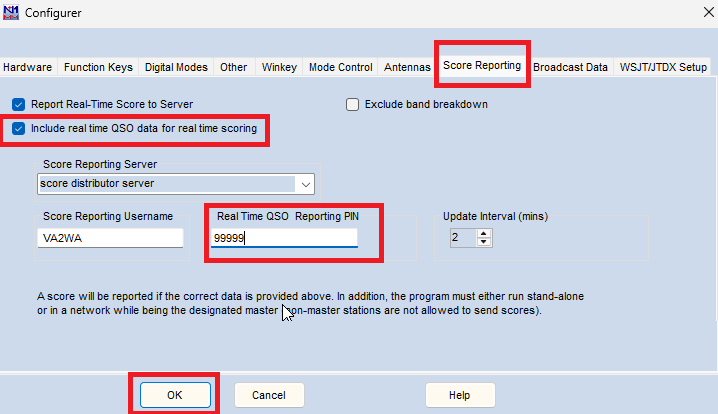
The RTC log should be set up with the following exchange settings: # 4-charcter grid location. Please don’t forget to put a space between # and the grid.
For example:

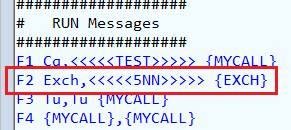
To add RST to your exchange in CW, setup your CW messages like on this example:
For DXlog users:
For those wanting to play with DXLog in the upcoming test, you should use the version 2.6.37 or higher.
To add RST to your exchange, reset your standard messages to default.
For SDC logger users:
Please download the latest. The RTC contest is supported started from the version 19.08 . It could be downloaded at https://www.lw-sdc.com/?page_id=79
For QARTest logger users:
Please download the latest. The RTC contest is supported started from the version 16.10.1 . It needs also QAR2GetScores version 2.0.4 (or the latest). It could be downloaded at https://www.ik3qar.it/software/qartest/en/download/
For HAMLOG.online logger users:
Go to your account at HAMLOG.online, open the Contest Logger, and select Real Time Contest (RTC). In Contest settings, choose your entry category and confirm your callsign and four-character grid locator.
HAMLOG sends QSO updates to the RTC server and displays live standings from Contest Online ScoreBoard. It also provides duplicate checking, Super Check Partial, CAT control, CW keying, editable contest messages, and much more. Check your callsign, category, and locator before operating.